Building Early Literacy and Problem-Solving Skills with The Christmas Activity Tracing Workbook Vol2
Seasonal educational materials serve a dual purpose: they capture a child’s natural excitement about holidays while channeling that energy into meaningful cognitive growth. The Christmas Activity Tracing Workbook Vol2 is one such resource that blends festive themes with structured skill-building. Whether you are a parent looking for after-school enrichment, an educator seeking classroom centers, or a homeschooling caregiver aiming for thematic learning, this workbook offers a wide range of exercises that go far beyond simple tracing. Below, we explore how each activity type contributes to development, who can use the book most effectively, and what practical considerations come into play when incorporating it into a learning routine.
The Developmental Rationale Behind Tracing and Activity Workbooks
Fine motor control, letter recognition, and visual discrimination are foundational skills that children begin to develop between ages three and seven. Workbooks that combine tracing with puzzles, games, and coloring provide repeated practice in a low-pressure format. The Christmas Activity Tracing Workbook Vol2 takes this concept and layers it with holiday imagery, which can increase motivation and sustained attention. When a child sees a Christmas tree, a snowman, or a reindeer on the page, the activity feels less like a drill and more like play. This emotional connection can lead to longer practice sessions and greater retention of concepts.
Moreover, tracing letters and shapes activates the same neural pathways used in handwriting and reading. By guiding a pencil along pre-printed paths, children build muscle memory for letter formation. The workbook’s inclusion of both uppercase and lowercase letter tracing ensures that learners encounter the full alphabet in context. Combined with coloring elements, the tracing pages encourage proper pencil grip and hand-eye coordination. These are not merely busywork sheets; they are carefully designed interventions that support pre-writing and early literacy milestones.
Exploring the Core Activity Types and Their Learning Outcomes
The workbook features multiple activity categories, each targeting a different cognitive or motor domain. Understanding what each exercise demands can help adults select the right pages for a child’s current skill level.
Mazes and Dot‑to‑Dot Puzzles
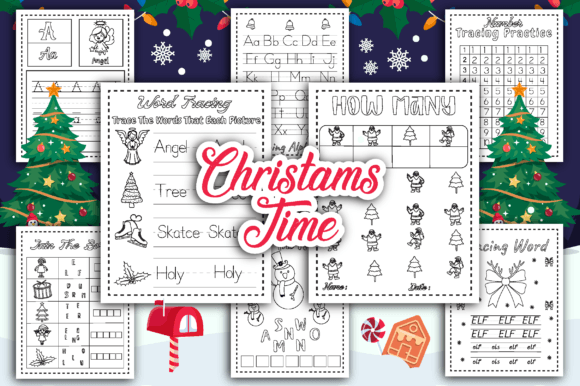
Mazes require forward planning and spatial reasoning. A child must visually scan the path, anticipate dead ends, and adjust their pencil direction accordingly. Dot‑to‑dot puzzles, on the other hand, reinforce number sequencing and order. When the dots are connected, a holiday image emerges, providing immediate visual feedback. Both activities strengthen problem-solving skills and persistence. In the Christmas Activity Tracing Workbook Vol2, these puzzles are themed around Santa’s workshop and winter scenes, which keeps engagement high.
Word Search and I Spy Games
Word searches demand visual scanning and pattern recognition. As children look for letters in sequence, they practice left‑to‑right tracking—a critical reading skill. I Spy games shift the focus to observational skills and vocabulary. A typical I Spy page in this workbook might ask the child to find five hidden ornaments among a tangle of gift boxes and candy canes. This strengthens selective attention and categorization. When used in a group setting, these games can also encourage oral language development as children describe what they see.
Color to Picture and Trace Letter and Color A‑Z
Coloring within lines continues to refine fine motor control. The “Color to Picture” activities add a cognitive layer: the child must match colors to specific areas, sometimes following a key. The “Trace Letter and Color A‑Z” pages combine letter formation with coloring, reinforcing the shape of each letter while allowing creative expression. Together, these activities offer a gentle introduction to following instructions and completing multi‑step tasks.
Learning Alphabet and Match Word with Picture
The alphabet pages move beyond tracing by presenting letters in various fonts and contexts. Some pages ask the learner to circle all instances of a target letter, which builds letter recognition fluency. “Match Word with Picture” connects written vocabulary to concrete images. For example, the word “sleigh” is placed next to a drawing of a sleigh, and the child draws a line to connect them. This is a foundational step in reading comprehension, as it requires the child to decode the word and link it to meaning.
Letter Board Game and Tic‑Tac‑Toe
Games introduce turn‑taking, strategy, and social interaction. The letter board game might involve rolling a die, moving a token, and naming the letter landed on. This format is ideal for small groups or one‑on‑one time with a parent. Tic‑Tac‑Toe, while simple, teaches basic logic and anticipation of an opponent’s move. When themed with Christmas symbols—such as snowflakes versus holly leaves—the game feels fresh and festive. These activities are particularly useful for breaking up longer workbook sessions and keeping children engaged.
Missing Word Game, Matching Game, and Left Right Game
Missing word exercises present a sentence or phrase with a blank, and the child selects the correct word from a list. This builds semantic understanding and sentence structure awareness. Matching games, whether with pictures, letters, or words, strengthen memory and classification skills. The “Left Right Game” is a spatial awareness activity: instructions like “draw a star to the left of the tree” require the child to distinguish between left and right, a skill that transfers to reading directionality and body awareness.
Shadow Matching, Counting Game, and Find Missing Word Game
Shadow matching asks children to connect an object to its silhouette, which exercises visual closure and shape constancy. Counting games involve enumerating holiday items—candy canes, ornaments, snowflakes—and writing the corresponding numeral. This reinforces one‑to‑one correspondence and number writing. “Find Missing Word Game” is similar to the earlier missing word activity but may involve longer passages or multiple blanks, challenging the child to use context clues more independently.
Word Tracing and Spelling Worksheet
Word tracing pages combine letter tracing with whole‑word practice. A child might trace “star,” “bell,” or “elf” several times, then write the word independently on a line below. This scaffolded approach gradually reduces support. Spelling worksheets take it a step further by presenting a picture and asking the child to spell the word. For early writers, this can be done with magnetic letters or by copying from a word bank. These activities are among the most advanced in the Christmas Activity Tracing Workbook Vol2 and are well‑suited for kindergarteners and first graders who have basic letter knowledge.
Who Benefits Most from This Workbook
The variety of difficulty levels within a single volume means that the workbook can serve multiple users in different ways.
Parents and Caregivers
For families looking to reduce screen time during the holiday break, the workbook offers a tangible, offline alternative. Parents can sit alongside their child and work through a few pages each day, creating a routine that blends learning with quality time. The clear instructions on each page mean that adults do not need a teaching background—they can simply guide and encourage. The 60‑page length provides enough material to last several weeks without repetition.
Classroom Teachers
Teachers can use the workbook in literacy centers, as morning work, or for early finishers during December. The inclusion of games like Tic‑Tac‑Toe and the letter board game makes it easy to pair students for cooperative learning. The “Match Word with Picture” and “Word Search” pages are especially useful for English language learners, as they provide visual context for new vocabulary. Since the workbook is print‑ready in multiple formats (PDF, JPG, PNG, EPS, AI), a teacher can print individual pages for a class of 25 without worrying about copyright restrictions for personal classroom use.
Homeschooling Educators
Homeschooling families often seek themed units that cover multiple subjects. This workbook touches on language arts (letter tracing, spelling, word matching), math (counting games, sequencing), and fine motor skills (coloring, tracing). It can be integrated into a larger Christmas unit study alongside books, crafts, and music. The A4 and 8.5×11″ size means it fits standard binders and folders, making it easy to store and organize.
Occupational Therapists and Intervention Specialists
Therapists who work on handwriting, visual perception, and executive functioning will find the workbook a useful supplement. Mazes and dot‑to‑dot exercises are commonly used in occupational therapy to improve hand control and visual tracking. The shadow matching and I Spy activities can be adapted for children with visual processing challenges. Because the workbook is black‑and‑white line art, it is also printer‑friendly and can be used with a variety of writing tools, from thick crayons to fine markers, depending on the child’s grip strength.
Practical Considerations for Daily Use
Having a resource that is ready to print and use is a major advantage in busy households and classrooms. The Christmas Activity Tracing Workbook Vol2 is delivered as a PDF, JPG, PNG, EPS, and AI file, all at 300 dpi resolution. This high resolution ensures crisp lines and clear images, which is especially important for tracing activities where the child needs to see subtle curves and endpoints. The 60 pages are designed to fit standard paper sizes, so no special trimming or scaling is required.
One practical tip is to print pages on heavyweight paper or cardstock if the child will be using markers, as the ink may bleed through standard copy paper. For pages that involve cutting (such as the matching game or letter board game), printing on cardstock increases durability. Laminating the board game and matching pieces can extend their use across multiple children or years.
Another consideration is order of use. While the workbook does not need to be completed sequentially, starting with the simpler activities—like coloring and maze pages—can build confidence. As the child progresses, the letter tracing and spelling pages can be introduced. The games are best used when a child needs a mental break or when two or more children are working together. By mixing active game pages with seated tracing pages, adults can keep sessions fresh and prevent fatigue.
For educators managing a classroom, the availability of separate file formats (PDF for easy printing, JPG and PNG for integrating into digital platforms, EPS and AI for custom editing) is a practical boon. A teacher could, for instance, extract a single maze image and paste it into a Seesaw activity for remote learners. This flexibility is rare in pre‑packaged workbooks and adds significant value for tech‑savvy educators.
Observations on Seasonal Learning and Engagement
The holiday season naturally brings excitement, but it can also bring distractions. Educational materials that lean into the theme can channel that excitement into productive learning. Children often associate Christmas with anticipation and joy, and a workbook that features Santa, reindeer, and presents taps into that positive emotional state. Observations from classrooms that use themed workbooks in December suggest that children are more willing to engage with writing and problem‑solving tasks when the content feels celebratory rather than routine.
Moreover, the workbook’s mix of independent and collaborative activities mirrors the social nature of the holidays. A child might complete a dot‑to‑dot alone, then play the letter board game with a sibling or friend. This natural ebb and flow between solitary and interactive work helps develop social skills alongside academic ones. The “Left Right Game” is a particularly good example of an activity that requires listening and following verbal directions, which is a skill used in group settings and in following classroom instructions.
There is also a cumulative sense of achievement when working through a 60‑page book. Children can see their progress as pages are completed, and finishing the entire workbook becomes a goal in itself. For parents and teachers, this provides a concrete artifact of the child’s effort and growth over the holiday period. The workbook can be saved as a keepsake, showing how a child’s tracing and coloring skills improved from the first page to the last.
Comparing Print Workbooks with Digital Alternatives
In an era of educational apps and online games, it is worth considering why a print workbook remains valuable. Digital activities often emphasize quick responses and immediate rewards, which can fragment attention and reduce deep focus. Tracing on a screen using a finger or stylus does not build the same fine motor skills as using a pencil on paper. The tactile feedback of a pencil moving across a page, the resistance of the paper, and the ability to see and correct mistakes in real time are all critical for handwriting development. The Christmas Activity Tracing Workbook Vol2 delivers these sensory experiences.
Additionally, print workbooks are immune to technical issues—no battery life, no Wi‑Fi dependency, no pop‑up ads. For families with limited screen time policies or for classrooms with device constraints, a printed workbook is a reliable and equitable resource. The availability of multiple file formats also means that the same workbook can be used across different operating systems and printers without compatibility concerns.
That said, the workbook can complement digital tools when used thoughtfully. A teacher might project a word search page on a smartboard for whole‑group instruction, then distribute printed copies for individual practice. This hybrid approach leverages the strengths of both media without sacrificing the benefits of hands‑on tracing and writing.
Adapting the Workbook for Different Learning Environments
One of the strengths of the Christmas Activity Tracing Workbook Vol2 is its adaptability. It is not tied to a single curriculum or teaching philosophy, which means it can be customized to fit various settings.
In a One‑on‑One Tutoring Session
Tutors can use the workbook to assess a child’s letter formation and visual processing. Observing how a child navigates a maze or matches shadows provides insights into their executive functioning. The tutor can then target specific weaknesses, such as difficulty with left‑right discrimination or letter reversals, using the relevant pages. The workbook becomes a diagnostic tool as well as a practice tool.
In a Multi‑Age Homeschool Group
With children at different skill levels, the workbook’s range of activities allows each child to work on something appropriate. A three‑year‑old might color pictures and trace simple lines, while a six‑year‑old works on spelling and the board game. The same book can serve an entire family, which is cost‑effective and reduces the need to purchase multiple separate workbooks.
In a Daycare or Preschool Center
Teachers can set up stations with different pages. One station might have the mazes and dot‑to‑dot puzzles, another the coloring and letter tracing, and a third the game activities. Children rotate through stations, which keeps them engaged and allows the teacher to facilitate small‑group instruction. The pages can be collected and compiled into a portfolio for each child, showing their progress over the month.
In a Therapy or Intervention Context
Occupational therapists can use the tracing pages to work on pencil control and hand strength. Speech therapists might use the “Match Word with Picture” and “I Spy” pages to target vocabulary and articulation. The games can be adapted for social skills groups, where children practice turn‑taking, following rules, and handling wins and losses gracefully. The workbook’s format is flexible enough to be integrated into individual education plans (IEPs) and therapy goals.
Key Takeaways for Maximizing the Workbook’s Potential
To get the most out of the Christmas Activity Tracing Workbook Vol2, consider the following strategies:
- Print a few pages at a time rather than the entire book at once. This allows you to gauge interest and difficulty before committing to the full set.
- Pair the worksheets with hands‑on materials like playdough or sand trays for multi‑sensory learning. For example, after tracing the letter “S” on paper, have the child form the letter in playdough.
- Use the game pages as a reward after completing more demanding tracing or spelling pages. This creates a natural incentive structure.
- Incorporate verbal narration. Ask the child to describe what they are doing (“I am tracing the line to the star”) to reinforce language and metacognition.
- Store completed pages in a binder or folder so the child can review their work and see improvement over time.
Ultimately, the workbook is more than a set of worksheets; it is a structured yet flexible tool that supports a range of developmental domains during a season that naturally invites wonder and play. By understanding the purpose behind each activity and tailoring its use to the child’s needs, adults can transform a simple tracing book into a powerful aid for literacy, fine motor skills, and cognitive growth.