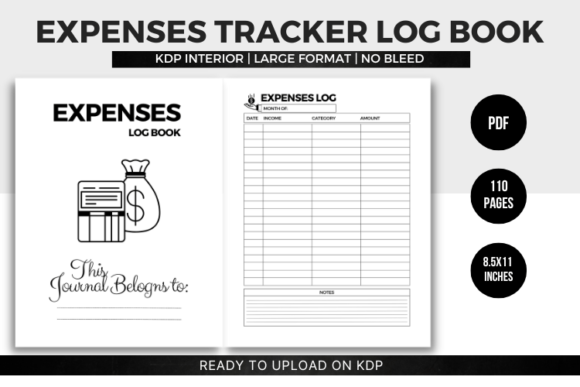
Expense Tracker Journal: Practical Money Management
Managing personal or business finances often feels like an uphill battle. The numbers blur, subscriptions pile up, and by month’s end, the question “Where did all the money go?” becomes all too familiar. An Expense Tracker Journal is not just a notebook—it’s a structured system that brings clarity to your cash flow. With its large 8.5x11 inch format, 110 pages of ready-to-use templates, and a PDF format that works seamlessly with KDP or your own printer, this journal turns fragmented receipts and mental notes into a coherent financial story. Whether you are a freelancer reconciling project costs or a small business owner tracking operational expenses, this tool offers a tangible way to regain control.
What makes this journal particularly interesting is its balance between simplicity and depth. Each page is designed to record daily expenses, monitor savings goals, and review budget adherence without requiring a degree in accounting. The physical act of writing—of seeing numbers flow from pen to paper—creates a sense of ownership that digital apps sometimes miss. For creative professionals, marketers, and entrepreneurs, this journal becomes a strategic asset: it helps you spot spending patterns, identify unnecessary costs, and redirect funds toward what truly matters—whether that’s gear for your next project, a course to upgrade your skills, or a buffer for lean months.
Creative Possibilities for Different Audiences
The true strength of an Expense Tracker Journal lies in its adaptability. A single template can serve multiple purposes depending on who uses it and how. Here are some ways different users can tailor the journal to their specific needs:
Freelancers and Gig Workers
For freelancers, income is rarely consistent. One month might bring a windfall, the next a drought. Using the journal to track both business expenses and personal spending helps you separate the two. Create a simple system: use one page per week for income, another for variable costs like software subscriptions, equipment, or client lunches. Over time, you can estimate your average monthly runway and set aside funds for slow periods. The journal’s large format gives you room to jot down notes about project timelines alongside expense entries—linking costs to specific gigs makes tax season far less stressful.
Small Business Owners
Running a small operation often means wearing every hat, including accountant. The journal can serve as a daily cash flow log. Record every outgoing—inventory, shipping, utilities, marketing spend—and compare it against incoming payments. Use the savings goal pages to plan for major investments like a new laptop or a trade show booth. The physical journal becomes a habit that keeps you grounded; when you see marketing costs eating 40% of revenue for three months straight, you are more likely to review your ad strategy critically.
Hobbyists and Side-Hustlers
Maybe you flip vintage furniture on weekends or sell handmade crafts online. Your hobby might generate profit, but only if you track material costs, shipping fees, and platform commissions. The journal helps you calculate whether your side venture is actually profitable or just an expensive pastime. Use the worksheets to set a monthly spending cap for supplies and track earnings. Over a few months, you’ll have clear data to decide if scaling up makes sense.
Families and Household Budgeters
Managing a household budget can feel like herding cats. The journal provides a shared space—a visual record of where the grocery budget went, how much the kids’ activities cost, and whether the emergency fund is growing. Because the journal is a PDF, you can print extra copies for different family members or use one master copy with color-coded sections. A simple key (black for fixed costs, blue for variable, red for savings) keeps everyone aligned without arguments over who spent what.
Adapting the Journal for Different Goals
The same template can serve very different financial goals. Here are three common scenarios and how to structure your journal pages accordingly:
- Debt Repayment: Dedicate the first few pages to listing all debts—credit cards, student loans, personal loans—with interest rates and minimum payments. Each month, use the daily expense section to track every dollar that could be redirected toward debt. The savings goal pages become debt payoff milestones. Seeing a line for “credit card A eliminated” gives a powerful motivational boost.
- Building an Emergency Fund: Set your savings target (three to six months of expenses) and break it into smaller weekly or monthly tiers. In the expense tracker, categorize spending into needs and wants. At the end of each week, calculate how much of the “wants” budget could have been saved. Transfer that amount mentally or physically into your fund. The journal’s pages let you record both the goal progress and the behavioral insights that lead to better choices.
- Investing for Growth: If your goal is to invest a certain percentage of income, use the journal to track spending categories that often inflate—dining out, entertainment, impulse purchases. Each page can have a small “investment potential” box where you note how much you could reallocate. Over time, you build a clear picture of your personal inflation leaks and correct them.
Realistic Examples of Use
Let’s look at two hypothetical users to see the journal in action:
Maya, a graphic designer, uses the journal to manage her freelance income. She prints out 10 blank pages at a time and keeps them in a binder. Each morning, she enters the previous day’s earnings and expenses. She has a color system: green for client payments, red for business costs, blue for personal. At the end of the month, she totals each category. She noticed that her software subscription costs had crept up to $120 per month for tools she barely used. By cutting two subscriptions, she saved $60 monthly—enough to fund a new illustration course. The journal’s physical presence kept the data front of mind, turning a vague feeling of overspending into a concrete action.
Jake, a boutique café owner, uses the journal to track daily overheads. He has a printed copy for each month. He records supplier deliveries, utility bills, and daily tips. His savings page tracks a goal to replace an old espresso machine. By reviewing his journal every Sunday, he spotted that milk deliveries were consistently over-ordered by 15%, leading to waste. He adjusted the order quantity and saved $200 per month. Without the journal, that waste would have stayed invisible. The large 8.5x11 pages gave him room to also note supplier phone numbers and delivery schedules directly on the expense row.
Keeping Your Expense Tracking Clear and Effective
To get the most out of your Expense Tracker Journal, a little structure goes a long way. Here are practical recommendations to maintain consistency and clarity:
- Set a daily time slot. Spend five minutes each evening entering the day’s transactions. Consistency beats intensity—a quick habit is more sustainable than a once-a-week marathon.
- Use categories that reflect your life. Don’t just copy generic labels. If you buy materials for your Etsy shop, create a “craft supplies” category. If you drive for Uber, have a separate “vehicle expenses” line. Specificity reveals actionable patterns.
- Review weekly, not monthly. Flip through the pages every Sunday. Look for surprises: a delivery fee you forgot, a subscription renewal. Early detection prevents budget drift.
- Combine with digital tools if needed. The journal doesn’t have to replace spreadsheets or apps—it can complement them. Use the physical journal for daily logs and a monthly summary page to transfer the data into a digital format for long-term trend analysis.
- Keep it organized spatially. Use one page per day or week, depending on your volume of transactions. Leave a margin for notes on why a particular expense was larger than usual (holiday, one-time repair). That context turns numbers into stories.
For content creators and educators, the journal also works as a teaching tool. If you run a workshop on financial literacy for entrepreneurs or beginners, you can design a simple exercise: have participants track one week of expenses on a printed page from the journal, then discuss patterns as a group. The large format makes it easy to write legibly and share visually. For bloggers or course creators, the journal’s template structure can be the basis for a downloadable resource that adds value to your audience—just ensure you follow KDP guidelines if you publish.
Ultimately, an Expense Tracker Journal is more than a record—it is a compass. It points you toward conscious spending, intentional saving, and financial decisions aligned with your real priorities. Whether you are an educator planning a budget for classroom supplies, a small business owner reviewing quarterly costs, or a freelancer aiming for consistent growth, these 110 pages offer a canvas for financial clarity. Print a copy, grab your favorite pen, and start turning your income into a tool for the life you want to build.