Math Activity Workbook for Grade 3: A Complete Resource for Teaching and Learning
Building strong number sense and problem-solving skills in third graders requires more than just worksheets—it demands a structured, engaging, and progressive approach. The Math Activity Workbook for Grade 3 is designed to meet exactly that need. Whether you are a classroom teacher preparing lesson plans, a homeschool parent mapping out the year, a tutor reinforcing core concepts, or an educator-publisher looking to create a high-quality KDP product, this workbook provides a ready-to-use framework that saves planning time while delivering consistent practice.
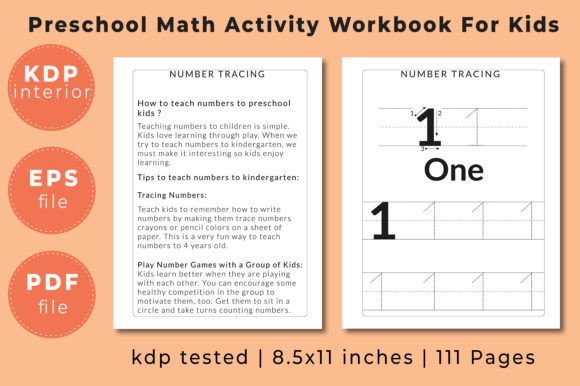
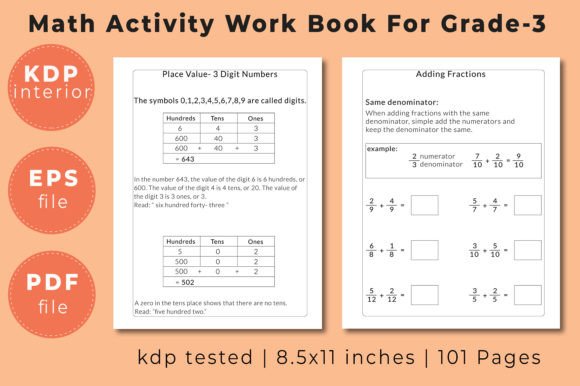
This 101-page, print-ready PDF (also available in EPS format) covers eleven essential math domains: place value, rounding, comparing numbers, addition, subtraction, multiplication, division, fractions, Roman numerals, word problems, and mental math. Each section is designed to be used flexibly—before a new concept is introduced, during guided practice, or after a lesson for reinforcement and assessment. In this article, you’ll learn how to integrate the workbook into real-world teaching and publishing workflows, along with practical tips for getting the most out of every page.
Where the Workbook Fits in Your Teaching Process
Effective math instruction is rarely linear. You introduce a concept, model it, guide students through examples, then let them practice independently before circling back for review. The Math Activity Workbook for Grade 3 supports each phase of this cycle.
- Pre-teaching preparation: Use the place value and comparing number sections to diagnose what students already know. The mental math pages can serve as a warm-up before diving into a new topic.
- Guided instruction: The addition, subtraction, multiplication, and division pages are scaffolded to allow you to complete the first few problems together, then release responsibility to the learner.
- Independent practice and homework: Each page is self-contained, making it easy to assign without extra explanation. Word problems are ideal for pair work or take-home practice.
- Review and remediation: The Roman numerals and fraction sections are perfect for spiral review. You can pull a page from any domain to revisit a skill that needs strengthening.
Because the workbook is not tied to a specific curriculum scope, you can sequence the topics in whichever order aligns with your teaching plan. The no-bleed 8.5″x11″ format ensures clean printing with no cut-off content, whether you’re using a home printer or a commercial print-on-demand service.
Eleven Math Domains, One Cohesive Resource
Let’s walk through each section and how it contributes to a third grader’s mathematical growth.
Place Value and Rounding Numbers
Place value is the foundation for all later arithmetic. The workbook starts with exercises that ask students to identify the value of digits, write numbers in expanded form, and round to the nearest ten or hundred. Rounding is taught as a practical estimation skill—useful before adding or subtracting large numbers to check reasonableness. In a classroom setting, you can pair these pages with base-ten blocks or number lines for a hands-on component.
Comparing Numbers
Students compare two numbers using >, <, and =, often working with multi-digit numbers. This section reinforces place value understanding and builds logical thinking. For workflow, use these pages as a quick exit ticket after a lesson on number ordering.
Addition and Subtraction
These sections cover up to four-digit addition and subtraction, with and without regrouping. The layout includes both vertical and horizontal formats, which helps students transition between algorithms and mental calculations. You can integrate these pages into a larger unit on multi-digit operations, using the workbook for daily drill and the textbook for problem-solving projects.
Multiplication and Division
By third grade, students begin memorizing multiplication facts and understanding division as sharing. The workbook includes fact practice, arrays, and basic division problems. For a publisher or educator, this section is especially valuable because it offers repetition without being monotonous—each page uses a slightly different layout to keep engagement high.
Fractions
Fractions are introduced with visual models (shaded parts of shapes) and simple comparisons. This is often the most conceptually challenging topic for third graders. The workbook’s fraction pages work best when used alongside physical fraction tiles or drawn diagrams. As a workflow tip: assign one fraction page per day during a two-week unit, then revisit the word problems section later to apply fractions in context.
Roman Numerals
Roman numerals appear less frequently in core curriculum, but they offer a valuable cross-curricular connection to history and clock faces. Use these pages as enrichment or as a fun Friday activity. Because they are self-contained, they require no special preparation.
Word Problems
The word problem section is arguably the most powerful part of the workbook. Problems cover addition, subtraction, multiplication, and division in real-world contexts like shopping, time, and measurement. For a teacher, these pages are ideal for small-group discussion—have students underline key information, choose an operation, and write a complete sentence answer. For a KDP author, a strong word problem section increases the workbook’s perceived value and helps it rank for high-intent keywords like “3rd grade math word problems worksheet.”
Mental Math
Mental math exercises encourage fluency without pencil and paper. They can be used as timed challenges or partner games. In a workflow, you might project the mental math page on a screen and have students call out answers, then later assign the same page for independent practice.
Practical Implementation Tips for Different Users
The workbook is not a one-size-fits-all resource—it adapts to your specific role and goals.
For Classroom Teachers and Homeschool Parents
Print the entire workbook at once and place it in a three-ring binder, or pull individual pages as needed. Because the PDF is high-quality print-ready, you can also export pages to a tablet app for annotation on a smartboard or iPad. If you teach multiple grade levels, combine this workbook with a second-grade version for differentiation. The EPS file gives you the flexibility to edit pages in vector software—resize, add instructions, or create your own custom versions.
To maintain consistency, assign two workbook pages per day (one from the current topic, one from a review topic). This spaced repetition pattern improves long-term retention. Keep a record of which pages each student completes; the straightforward layout makes grading fast.
For Self-Publishers and KDP Creators
If you are publishing math workbooks on Amazon KDP, this interior file is already tested and formatted. The no-bleed 8.5″x11″ size meets KDP’s trim requirements without adjustment. You can use the PDF as-is or rebrand it with your own cover and metadata. Because the content covers the full third-grade math curriculum, it appeals to both classroom teachers and parents seeking supplemental practice. When writing your book description, highlight the eleven domains, the 101-page count, and the inclusion of word problems and mental math—these features align with what buyers search for.
For a low-content business, this workbook can be the centerpiece of a series. You could split the 101 pages into shorter themed booklets (e.g., “Multiplication and Division for Grade 3” or “Word Problems for Third Graders”). The EPS file allows you to extract and rearrange sections quickly.
For Tutors and Intervention Specialists
Target specific weaknesses by pulling pages from the relevant domain. If a student struggles with regrouping, work through the subtraction section one page at a time. The spiral format (new problems on each page) reduces anxiety because students see a fresh start every day. You can also laminate a few key pages and use them with dry-erase markers for repeated practice.
Quality, Consistency, and Long-Term Use
A workbook is only as valuable as its accuracy and usability. This resource has been KDP-tested, meaning margins, bleed, and trim lines are correct for print-on-demand. The high-resolution PDF ensures crisp fonts and clear number formation—critical for young learners who are still mastering handwriting. The EPS file provides a backup for any future modifications.
For long-term use, consider storage: bind the pages with a comb or spiral coil so the workbook lies flat. Digital users can import the PDF into note-taking apps like GoodNotes or Notability and assign pages through a learning management system. Because the workbook is printable, it also works in low-tech environments where internet access is limited.
Consistency is built into the design. Each page has a header indicating the skill, a clear set of instructions, and ample workspace. Students spend more time thinking and less time decoding confusing layouts. Teachers can trust that the content aligns with Common Core standards (though not explicitly labeled) and covers the typical third-grade scope.
Integrating with Other Resources and Methods
A workbook is most effective when combined with manipulatives, games, and verbal reasoning. For example, after completing a rounding page, have students explain their thinking aloud. After a Roman numerals page, challenge them to decode a few classroom clock labels. The mental math pages can be turned into timed competitions that build speed while using the same skills from earlier chapters.
If you follow a math workshop model (mini-lesson, guided groups, independent work, centers), the workbook fits into the independent work or center rotation. Pair a fraction page with a set of fraction cards for a hands-on center. Use the word problems as the basis for a “problem of the day” routine.
For publishers, combining this interior with a glossy cover and a clear table of contents creates a professional product that competes on both quality and price. The 101-page count hits the sweet spot—thick enough to feel substantial, but not so long that printing costs become prohibitive.
Final Observations
The Math Activity Workbook for Grade 3 is not just a collection of worksheets. It is a structured system that simplifies planning, reinforces key concepts, and adapts to multiple teaching and publishing workflows. By using the place value, rounding, comparing, operations, fractions, Roman numerals, word problems, and mental math sections together, you create a comprehensive math practice environment that respects your time and your students’ learning pace.
Whether you print it today, upload it to KDP tomorrow, or integrate it into your homeschool routine for the entire year, the workbook delivers consistent, high-quality practice. And because it includes both PDF and EPS files, you retain full control over customization and future editions. For any adult serious about teaching third-grade math efficiently, this resource offers a practical, low-friction solution that works from day one.